



Bullshit. If there ever was one major dimension of human behaviour that is always diplomatically overlooked, this is it. It is everywhere. All of the time. Endless and so pervasive as if it forms part of the fabric of the universe we inhabit (or the simulation for that matter). Some times it is obvious. Mostly it is undercover, operating in insidious ways to control behaviour and crush critical thinking. It can be as harmless as a distraction between idiots on social media or as deadly as the undercover engine driving fake news and spreading disinformation.
“One of the most salient features of our culture is that there is so much bullshit.”
— Harry Frankfurt, On Bullshit (2005)
When the Princeton philosopher Harry Frankfurt sat down to write what would become one of the most cited academic papers in history, he wasn’t being provocative for the sake of it. He was making a precise observation about the modern condition: we are drowning in it. Not lies exactly — lies at least respect the truth enough to try to conceal it. Bullshit, Frankfurt argued, is something far more dangerous. The bullshitter doesn’t care whether what they say is true or false. They care only about the effect.
I thought about this a lot recently. I am probably rather unqualified to pontificate on the subject of truth in financial markets. Which, ironically, probably makes me more qualified than most of the people who do it for a living.
Here’s my thesis, in a nutshell:
Bullshit has Velocity
Data has Friction
In the post-truth financial ecosystem, narratives propagate at the speed of light in fibre optic cables while facts travel on foot, uphill, in the rain. And this asymmetry is not just an epistemological curiosity for philosophy departments — it’s a potential P&L event with real consequences for anyone with capital at risk.
“The amount of energy needed to refute bullshit is an order of magnitude bigger than that needed to produce it.”
— Alberto Brandolini (Brandolini’s Law)
A Brief and Incomplete History of Financial Bullshit
Let’s take a tour. The museum of financial narrative-over-data is vast and well-stocked, but a few exhibits deserve special attention.
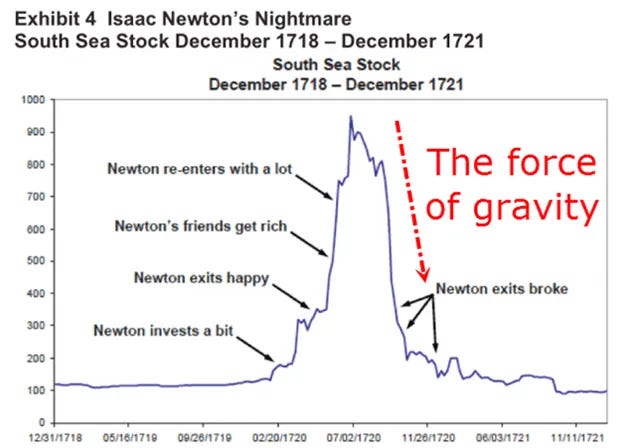
The South Sea Bubble (1720) is where we must start, because it features the greatest mind in human history getting absolutely rinsed. Isaac Newton — the Isaac Newton, the man who literally described gravity — made an early investment in the South Sea Company, sensed the market was overheating, and sold his position for a tidy £7,000 profit. A 100% return. The data, such as it was, told him to walk away.
But Newton couldn’t resist the narrative. As shares continued to soar, driven by hype about imaginary South American riches and government-sponsored propaganda, he bought back in near the peak. When the inevitable collapse came, he lost £20,000 — the equivalent of roughly £3.5 million today. His reported comment has echoed down three centuries of market history: “I can calculate the motions of the heavenly bodies, but not the madness of people.”
The man who defined the laws of motion could not define the laws of FOMO.
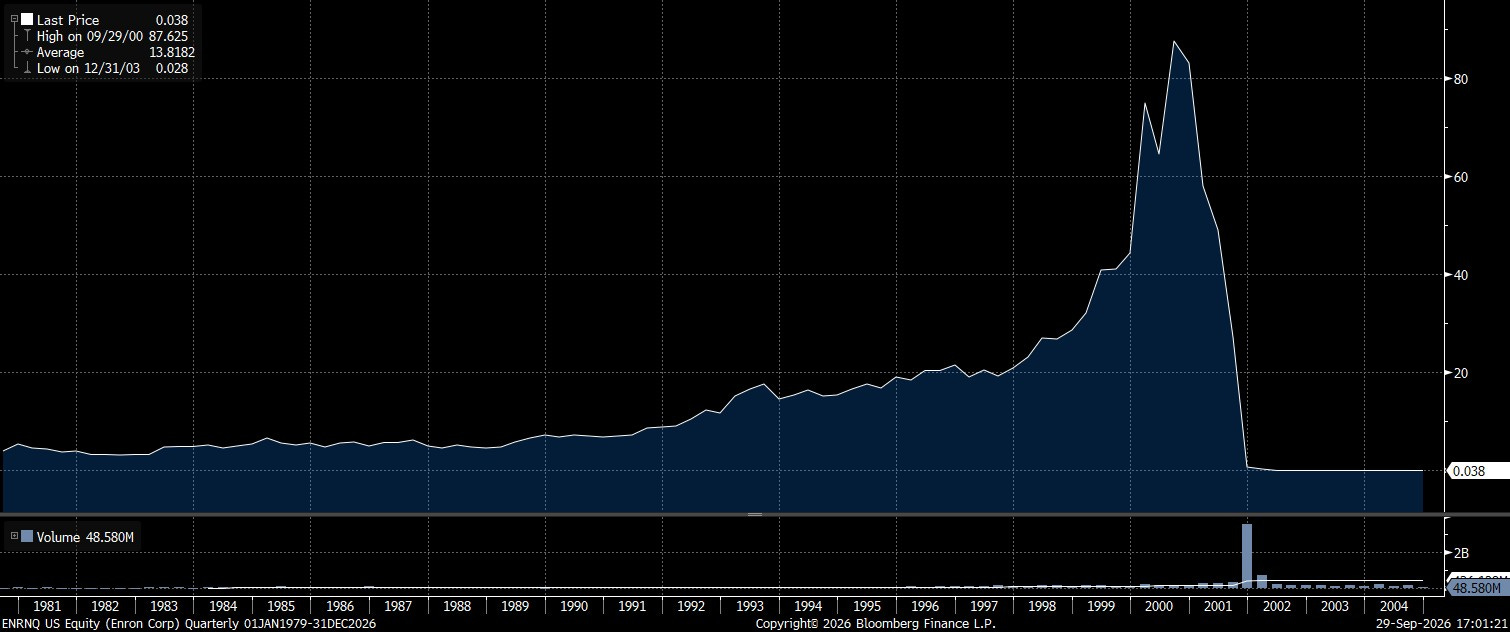
Enron (2001) is the modern masterpiece of the genre. One I witnessed personally on the other side of a Bloomberg terminal. Here the data was not just available — it was everywhere. The balance sheets, the accounting irregularities, the off-balance-sheet vehicles with names that sounded like cartoon villains (LJM, Raptor, Chewco). Analysts at major banks maintained buy ratings while the company was essentially running a Ponzi scheme. Why? Because the narrative — visionary management, energy trading revolution, new paradigm — was too seductive to question. And because, as Upton Sinclair reminded us:
“It is difficult to get a man to understand something when his salary depends upon his not understanding it.”
2008 took this dynamic to industrial scale. The Global Financial Crisis was, at its core, a narrative problem. The narrative said: “housing prices only go up.” The data — visible in every mortgage tape, every delinquency report, every CDO tranche analysis — screamed otherwise. But AAA ratings had become the financial equivalent of “trust me bro.” By the time the data could no longer be ignored, the damage to the global economy was measured in the trillions and the human cost was immeasurable. The few people who actually read the data were either ignored, ridiculed, or fired.
The Velocity Problem
So why does bullshit win the sprint? The answer is structural, and the problem has gotten exponentially worse.
Social media is an accelerant. The GameStop saga of January 2021 was perhaps the purest expression of narrative-over-data in market history. A struggling brick-and-mortar video game retailer went from $18 to $483 in three weeks — a 2,500% move — driven primarily by rocket emojis, diamond hand memes and a loosely coordinated army of retail investors on Reddit’s WallStreetBets. The stock had 140% short interest, and the “thesis” (if we’re being generous with that word) was essentially: “what if we just… didn’t sell?” By the time the stock peaked, the subreddit had gained six million new subscribers in a matter of days. One kid reportedly announced in a video game chat that he’d made $15,000 that day trading on his brother’s Robinhood account.
The data said GameStop was a business in secular decline. The narrative said it was a revolution. The narrative won — until it didn’t, and millions of late-arriving retail investors were left holding the bag while Wall Street, as usual, found a way to profit from the carnage.

The 24-hour news cycle creates narratives faster than reality can produce data. The same 2% market move is framed as “a healthy correction” on one network and “a bloodbath” on another, depending on editorial disposition and, one suspects, whether the anchor’s and management’s personal portfolio is long or short. Financial media doesn’t report markets — it manufactures context, and context is basically narrative.
Charismatic founders weaponize the velocity gap. Theranos. WeWork. FTX. The pattern is remarkably consistent: a compelling storyteller, a suspension of due diligence, and data that nobody wants to hear because the narrative is too intoxicating. Elizabeth Holmes’ black turtleneck was more persuasive than any lab result. Sam Bankman-Fried’s shorts and t-shirt projected “too smart to care about appearances,” which Wall Street interpreted as “too smart to commit fraud.”

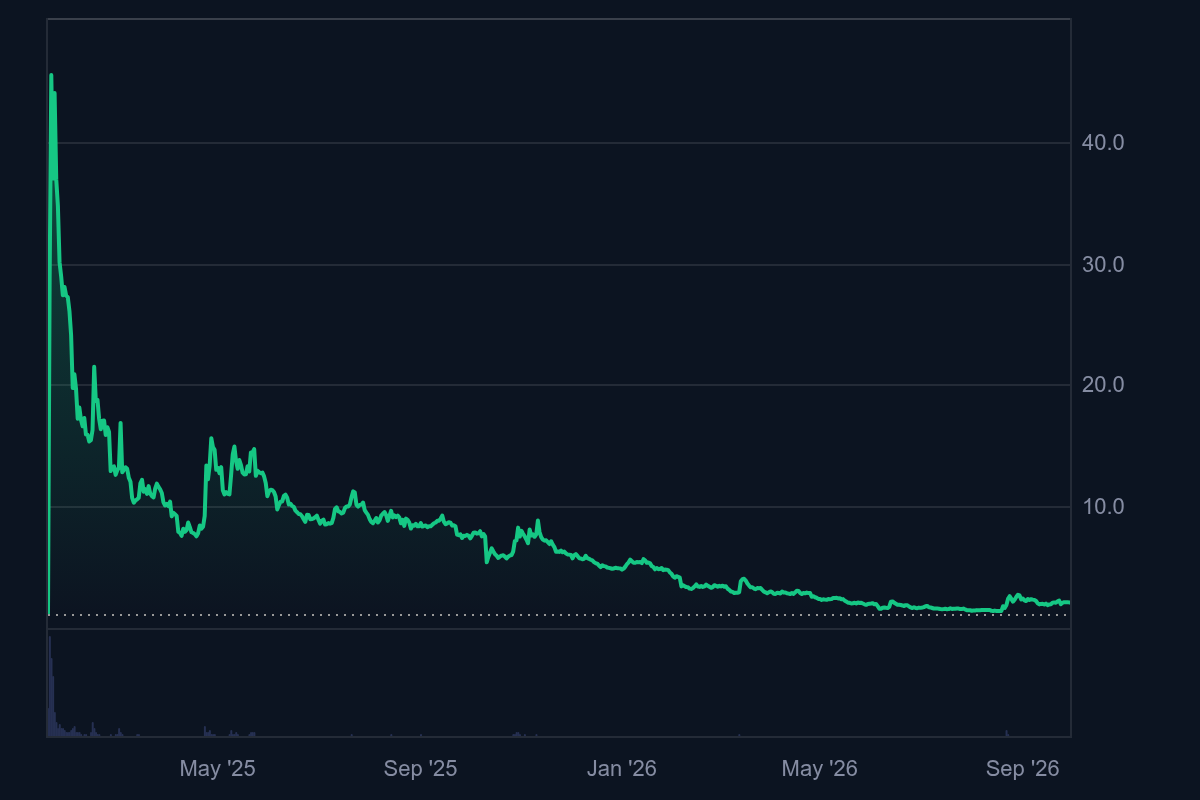
And then there’s the most recent specimen of the genre: the $TRUMP meme coin, launched three days before inauguration in January 2025. A token with no underlying asset, no revenue, no product, no nothing — that reached a fully diluted market cap of $72 billion within 48 hours. Seventy-two billion dollars ffs. For a digital token whose stated purpose was “an expression of support.” While over 800,000 wallets collectively lost $2 billion trading it, the insiders reportedly netted hundreds of millions. If Frankfurt were updating his treatise, this would be Exhibit A.
The Herd: A Field Guide
“Whenever you find yourself on the side of the majority, it is time to pause and reflect.”
— Mark Twain
The relationship between bullshit velocity and herd behaviour is symbiotic. Narratives create herds, and herds amplify narratives. Allow me to present a taxonomy:
The FOMO Herd buys at the top because “everyone else is making money.” The data says the asset is overvalued by every conceivable metric. The narrative says “this time is different.” These four words have destroyed more capital than wars, bad divorces and natural disasters combined.
The Narrative Tourists don’t understand the asset, the sector, or the instrument. But they’ve seen a TikTok about it. These are the participants Keynes warned about in his beauty contest analogy — except now the beauty contest is conducted via Instagram Stories with a six-second attention span audience.
The Sophisticated Herd is the most dangerous species. Institutional investors who know the data is bad but ride the narrative anyway because quarterly performance reviews don’t reward early contrarianism. They understand Brandolini’s Law intellectually, but their bonus depends on ignoring it practically. The DeepSeek sell-off of January 2025 was a textbook example: Nvidia lost $589 billion in market value in a single day — the largest single-day loss in US market history — because a Chinese startup released an app over a weekend. The narrative flipped from “AI spending is an unstoppable megatrend” to “maybe this whole thing was overhyped” in approximately 14 hours. By the end of the week, the stock had recovered most of its losses. The data hadn’t changed. The narrative had done a complete lap.
The Contrarian Herd is the most ironic species: people who believe they’re independent thinkers but are actually all reading the same “contrarian” newsletters and following the same “non-consensus” accounts. Present company included … possibly.
The Inconvenience of Data
Why is data structurally disadvantaged against narrative?
Data is boring. Narratives are exciting. Nobody ever got a million followers posting balance sheet analysis. But post a hot take about how a meme coin will replace the dollar and you’re an influencer. The democratisation of financial markets via zero-commission trading apps has created millions of participants who can execute a derivative trade in three taps.
Data has latency. Narratives are instant. By the time you’ve completed proper due diligence on a company, the stock has moved 40% on a rumour tweet. The tariff saga of early 2025 illustrated this beautifully: markets would swing violently on a single social media post from the White House, only to reverse days later when the policy was walked back, only to swing again when a new tariff was announced. The S&P 500 briefly fell below 5,000 for the first time in a year — not because the underlying economy had materially changed, but because nobody could figure out whether yesterday’s trade policy would survive until Thursday.
Data can be weaponised as narrative. Cherry-picking statistics, survivorship bias, the infamous truncated Y-axis — data itself becomes a tool of the bullshit industrial complex when wielded by motivated storytellers. In a world where you can find a chart to support literally any thesis, the chart is no longer evidence. It’s decoration.
And here’s the deeper problem — the one the philosophers saw coming. The American logician W.V.O. Quine argued in his landmark 1951 essay Two Dogmas of Empiricism that our beliefs about the world don’t face the test of experience individually — they face it “not individually but only as a corporate body.” He called this the web of belief: an interconnected fabric of assumptions, theories and observations where no single data point can decisively refute any single belief. When a new piece of data contradicts the prevailing narrative, the web doesn’t snap — it adjusts. The narrative absorbs the anomaly, reinterprets it, explains it away. Inflation data comes in hot? “Transitory.” Earnings miss estimates? “Already priced in.” Unemployment spikes? “Lagging indicator.”
Quine’s thesis of underdetermination — the idea that the same evidence can support multiple incompatible theories — is essentially the philosopher’s way of describing what every trader already knows intuitively: bulls and bears can look at the same data and reach opposite conclusions, and both can be internally consistent. The data doesn’t settle the argument. The narrative does. This is, Quine would argue, the structural condition of all human knowledge.
Quine also observed, with characteristic dryness, that “creatures inveterately wrong in their inductions have a pathetic but praiseworthy tendency to die before reproducing their kind.” Financial markets, alas, are not subject to natural selection — bad narratives can reproduce indefinitely, sustained by leverage, liquidity and the inexhaustible human appetite for a good story.
“Facts are stubborn things”
— John Adams
So what can you do about this ?
I am not here to moralise (that would be its own form of bullshit). But I do think there are some practical implications for anyone trying to preserve and grow capital in the New Age of Narrative symbolized appropriately by the acronym … NaN. (Damn I love how appropriate this acronym is !)
Accept the velocity differential. You cannot outrun bullshit. You can, however, position yourself for when it runs out of fuel. Every narrative-driven rally has a half-life. The question is not if but when reality reasserts itself.
Cultivate boredom tolerance. The ability to sit through earnings calls, read footnotes, and study and explore datasets is the most underrated competitive advantage in modern finance. The bullshit merchants cannot compete with someone willing to be bored.
Structure for narrative exhaustion. Asymmetric positioning — tail risk hedges, options structures, long-volatility allocations — are essentially bets that the market will eventually remember that data exists. They are, in a sense, long convexity bets against the permanence of bullshit.
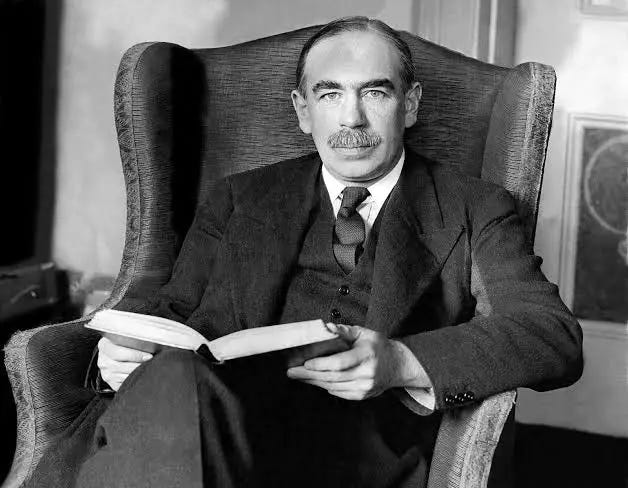
Think in supertanker timeframes. This is, and has always been my fundamental thesis. Long-term macro trends outlast short-term narrative noise — always have, always will. The trick is staying solvent long enough to see it. As a certain Cambridge economist once wrote:
“The market can stay irrational longer than you can stay solvent.”
— J. M. Keynes
The velocity of bullshit is, I’m afraid, only going to increase. AI-generated content, deepfakes, algorithmic amplification — the tools of narrative production are getting faster and cheaper by the day. But data, stubborn and unfashionable as it is, has one decisive advantage over narrative: it doesn’t have to keep running. It just has to be right.
“Everyone is entitled to his own opinion, but not to his own facts.”
— Daniel Patrick Moynihan

I occasionally share market commentary and random musings on here. None of this content should be taken as financial advice or heaven forbid life advice. Proceed by your own risk. DYOR comrades.
Connect with me on LinkedIn and subscribe to get these posts delivered by email.